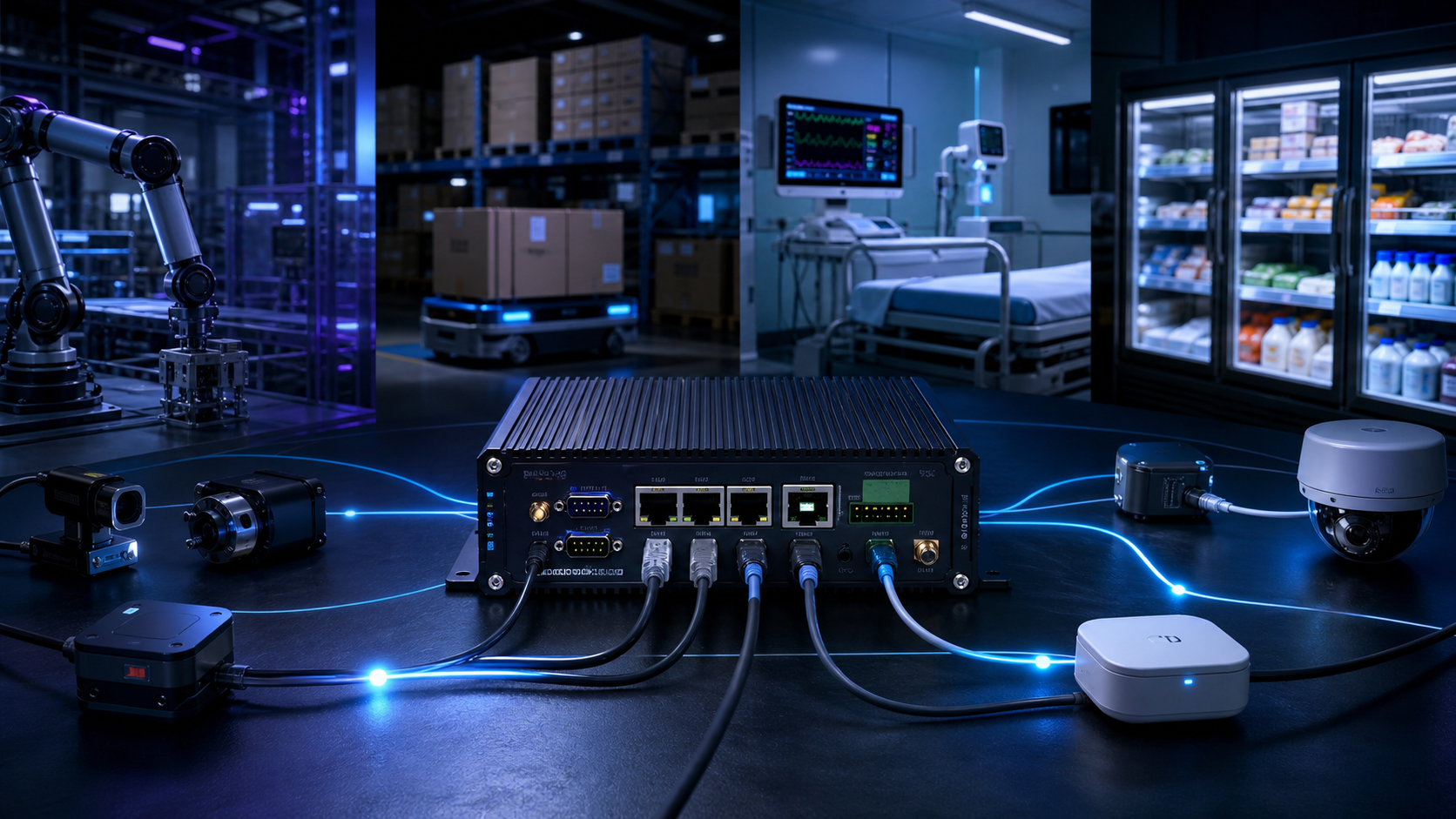
IoT Gateways: The Key to Connected Manufacturing, Logistics, Healthcare, and Retail
Internet of Things (IoT) gateways are emerging as critical building blocks for digital transformation across industries. An IoT gateway is a device or software that links the physical world of sensors, machines, and devices to the cloud or data center. It aggregates data from diverse edge devices (machines, vehicles, wearables, etc.), translates different protocols, and often performs local processing before relaying information onwardtrugemtech.comfortinet.com. In essence, the gateway serves as the nerve center of an IoT network – enabling real-time monitoring, control, and analytics for smarter operations. This article explores why IoT gateways are essential and how they drive innovations in manufacturing, logistics, healthcare, and retail, with real-world examples illustrating their impact.
Why IoT Gateways Are Essential for IoT Solutions
In any IoT deployment, simply connecting each device directly to cloud servers can be inefficient or even impractical. Different devices may speak different protocols (e.g. a factory sensor using Modbus, a warehouse meter using Zigbee), and sending raw data from thousands of endpoints straight to the cloud can strain bandwidth, increase latency, and raise security concerns. IoT gateways solve these challenges by acting as intelligent intermediaries:
- Unified Connectivity & Protocol Translation: Gateways support multiple industrial and wireless protocols (Modbus, OPC-UA, Zigbee, Bluetooth, Wi-Fi, cellular, etc.), translating and standardizing data from disparate sources into a format the cloud or central system understandstrugemtech.com. This lets modern sensors and legacy equipment all communicate through one hub. For example, an IoT gateway can link modern IoT sensors and decades-old PLC machines on a factory floor by bridging Fieldbus and Ethernet protocols into a single data streampremioinc.com.
- Local Data Processing & Reduced Latency: Unlike basic “cloud-only” setups, advanced IoT gateways can process and filter data at the edge, near the source. This edge computing capability means critical decisions don’t have to wait for cloud round-tripstrugemtech.com. The gateway can perform real-time analytics (e.g. checking sensor thresholds or running AI models) and send back control commands within milliseconds. Local processing reduces latency and keeps operations safe – a fast gateway can stop a machine immediately if a hazard is detected, rather than waiting for a cloud server to respondfortinet.comfortinet.com.
- Enhanced Security & Data Management: An IoT gateway serves as a checkpoint for data. It can authenticate devices, encrypt sensor data, and enforce access control before anything reaches the cloudfortinet.com. By filtering noise and outliers, gateways also reduce the volume of data sent upstream. This not only protects networks from overload but also improves privacy (sensitive raw data can be processed locally, sending only necessary results to the cloud).
- Reliable Connectivity and Failover: IoT gateways often come with multi-network connectivity – for instance, Ethernet, Wi-Fi, and 4G/5G cellular all in one device. This provides redundant communication paths. If the primary network goes down, the gateway can seamlessly switch to a backup (e.g. failover from wired internet to a cellular network) so that critical devices stay onlinezipitwireless.com. For example, in retail settings a smart gateway might automatically swap to LTE if the store’s broadband fails, ensuring point-of-sale devices and sensors remain connected without interruptionzipitwireless.com.
- Simplified Device Management: Rather than managing hundreds of IoT endpoints individually, organizations can manage a few gateways which in turn handle the devices. Our IoT gateway solution, for instance, includes a central management dashboard to update firmware, monitor status, and configure all connected devices through the gateway. This hub-and-spoke model streamlines deployment and scalability for large IoT networks.
In short, an IoT gateway provides the bridge and brains for IoT – bridging devices to the cloud and adding intelligence along the way. It’s both an interpreter and a traffic cop for data. Businesses leveraging IoT gateways gain more robust, secure, and scalable systems compared to connecting sensors directly. Below, we delve into how gateways are powering IoT use-cases in manufacturing, logistics, healthcare, and retail, and how our own offerings in these areas stand out against the competition.
Industrial robots on a factory production line. IoT gateways connect such machines and their sensors to higher-level systems, enabling real-time monitoring, predictive maintenance, and autonomous control in smart factories.
IoT Gateways in Manufacturing (Industry 4.0)
In the manufacturing sector, IoT gateways form the backbone of Industry 4.0. Modern factories have a mix of new smart machines and legacy production equipment, all generating valuable data. An IoT gateway integrates these fragmented systems into one intelligent network. It connects sensors on the shop floor (vibration monitors, temperature and pressure sensors, vision systems, etc.) with production-line PLCs and edge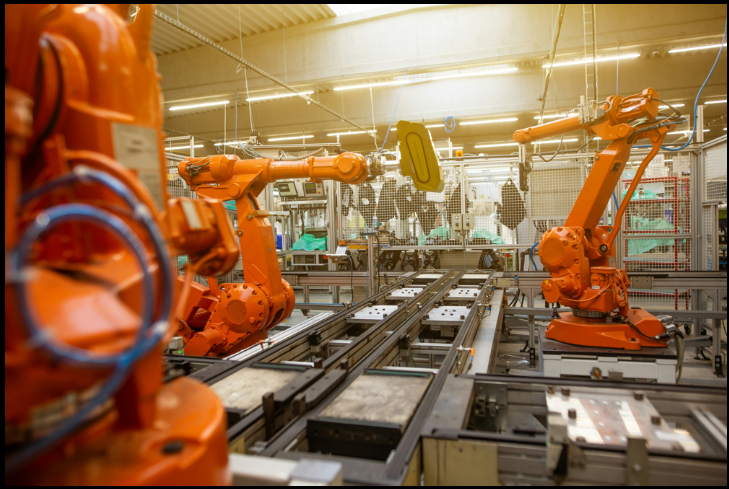 controllers, and ultimately with cloud analytics or MES (Manufacturing Execution Systems)acrosser.com. This real-time visibility and control loop is what enables smart manufacturing.
Key benefits in manufacturing include: (1) predictive maintenance, (2) improved quality and OEE (Overall Equipment Effectiveness), and (3) flexibility for mass customization. For example, IoT gateways can continuously stream machine performance data to AI models that predict failures before they happen. This has allowed manufacturers to service equipment proactively and avoid costly unplanned downtimeacrosser.com. Gateways also buffer and sync data from fast-moving machines to local control systems. If a sensor detects a quality deviation, the gateway can trigger adjustments on the fly (or even adjust machine settings itself in an edge computing scenario) to reduce defects.
A shining real-world example is Siemens’ electronic manufacturing plant in Amberg, Germany. Dubbed one of the world’s most advanced “digital factories,” this facility leveraged IoT gateways to connect its vast array of machines and conveyor systems into a unified, feedback-driven networkacrosser.com. The result? Production volume increased 13-fold without expanding the factory’s physical footprint, and over 75% of the plant’s processes are automated. Siemens uses IoT gateways to aggregate data from each production station and feed digital twin models that coordinate the line for optimal flow. If one line slows down, upstream machines automatically adjust – all enabled by gateway-mediated data. This data-centric agility led to higher output, better product quality, and significant cost savingsacrosser.com.
Our own Industrial IoT Gateway solutions for manufacturing highlight these benefits. For instance, our gateway devices support industrial protocols like PROFINET and EtherNet/IP, allowing manufacturers to connect both modern robot arms and decades-old CNC machines through one platform. This was evident in a recent deployment for a client retrofitting a factory – the gateway acted as a translator that linked new IIoT sensors with legacy machinery, bridging old and new seamlesslypremioinc.com. Compared to competitor technologies that might require separate interfaces or cloud adapters for each machine, our gateway provided a one-stop, secure edge hub with local processing. The result was a unified dashboard showing every machine’s status in real time, plus the ability to run on-site analytics for things like cycle time optimization. In head-to-head comparisons, this edge approach outperformed a purely cloud-based system – decisions that took seconds via cloud were executed in milliseconds on our gateway, improving safety and efficiency on the factory floor.
IoT Gateways in Logistics and Supply Chain
The logistics sector – encompassing transportation, warehousing, and supply chain management – is undergoing an IoT revolution for end-to-end visibility. Here, IoT gateways are the linchpin that connects mobile and remote assets to central systems. Consider a fleet of delivery trucks, each with engine sensors, GPS trackers, and perhaps an RFID reader for inventory. An IoT gateway installed in each truck can collect all that data (location, temperature of cargo, driver behavior) and transmit it in real time back to logistics managers. Without the gateway, these disparate sensors might never “talk” to each other or would require each to have its own cloud connection (which is costly and hard to manage). The gateway consolidates data and ensures reliable communication even as assets are on the move.
Use cases in logistics include: asset tracking, fleet management, cold chain monitoring, and warehouse automation. For example, in cold chain logistics (transporting food or pharmaceuticals), gateways gather readings from temperature and humidity sensors in a refrigerated truck and instantly alert if thresholds are breached. They might also interface with the truck’s telematics. Logistics managers get a live stream of conditions and can act (e.g. instruct a driver to check a freezer unit) before any product is spoiledretailtouchpoints.comretailtouchpoints.com.
One powerful real-world example is the pharmaceutical supply chain platform by Controlant. Controlant equips shipments of vaccines and medicines with IoT devices that include cellular-connected gateways. As packages travel worldwide, these gateways continuously transmit data on location, temperature, and humidity to Controlant’s cloud dashboardretailtouchpoints.com. If a pallet sitting on an airport tarmac gets too warm, an alert is generated immediately so the shipment can be moved or cooled. Using around 200,000 IoT SIM-enabled devices (many acting as gateways for local sensors), Controlant and its customers track goods in real time, ensuring compliance with strict storage conditionsretailtouchpoints.com. This level of visibility was unheard of before – now clients like vaccine distributors can pinpoint exactly where a delay or temperature excursion occurred in transit and take action. IoT gateways made this possible by reliably funneling data from every step of the supply chain into one system, even across international and infrastructurally weak areas.
A LoRaWAN IoT gateway installed on a building (right side with antenna). Such gateways enable long-range, low-power connectivity for distributed assets – for example, linking environmental sensors or trackers in a logistics network to the cloud via the LoRaWAN network.
In another case, Oklahoma Gas & Electric deployed rugged IoT gateways (Sierra Wireless AirLink) at field sites like pipeline pump stations to monitor equipment status in real timeacrosser.com. While this crosses into the energy sector, it’s fundamentally a remote logistics challenge – the utility’s assets are geographically dispersed with limited connectivity. By using cellular IoT gateways that can handle harsh conditions (class I div II rated for hazardous locations), they achieved near real-time telemetry of pressure, flow, and equipment alarmsacrosser.com. This saved countless manual inspection trips (since data was remotely accessible) and improved safety by detecting anomalies earlyacrosser.com. The lesson for any logistics/supply operation is clear: IoT gateways extend your visibility to the edge of your network, be it a truck on a highway or a pump in a remote field.
From a competitive standpoint, our Edge Logistics Gateway offerings emphasize reliability in transit. Unlike some consumer-grade routers repurposed for vehicles, our gateways are purpose-built for fleet and remote asset management – featuring dual cellular modems, GPS, and battery backup. One client, a global retailer, piloted our solution to monitor a fleet of delivery trucks in real time (location, refrigeration status, door open/close events). Compared to a competitor’s solution that attempted to use individual sensor SIMs (leading to higher data costs and patchy coverage), our single integrated gateway per truck proved more cost-effective and robust. It buffered data when signal was weak and uploaded it when coverage returned, ensuring no data was lost (a capability standard in our devices). This blend of edge intelligence and connectivity options (3G/4G, LoRaWAN, Wi-Fi) is a key differentiator that competitors often lack. The bottom line: IoT gateways give logistics operators actionable insights from the field, improving efficiency, reducing losses, and ultimately delighting customers with more predictable deliveries.
IoT Gateways in Healthcare
In healthcare, the IoT’s promise is to improve patient care and operational efficiency through continuous monitoring and smart automation. IoT gateways play a pivotal role in the “Internet of Medical Things” (IoMT) by securely linking health devices and sensors to clinical systems. Hospitals and clinics are filled with devices that can benefit from connectivity – patient vital sign monitors, IV pumps, EKG machines, even “smart beds” that detect occupancy and posture. Outside healthcare facilities, wearables and home health sensors allow remote patient monitoring. An IoT gateway is often the intermediary that collects data from these medical devices (many using Bluetooth Low Energy, Wi-Fi, or proprietary protocols) and sends it to a central platform or electronic health record system. Crucially, gateways in healthcare must prioritize security (to protect sensitive patient data) and reliability (often life-critical).
Use cases in healthcare include: remote patient monitoring, asset tracking in hospitals, and smart healthcare facilities. For instance, a wireless patient monitoring solution might use a small gateway in a hospital ward to gather data from multiple wearable patient sensors. Instead of nurses manually checking vitals every hour, the sensors (like a chest patch measuring heart rate, respiratory rate, etc.) broadcast continuously to the gateway. The gateway can preprocess this data and alert staff smartphones or central nursing station if any vitals go out of range – effectively creating a semi-automated ICU step-down unit. This was invaluable during COVID-19 surges, where caregivers could not be at the bedside for infection risk or due to PPE shortages.
A compelling real-world example is the partnership between Philips Healthcare and Cassia Networks in a major Dutch hospital’s COVID-19 ward. Philips developed a compact, medical-grade wearable biosensor (the Philips BX100) that patients wear on their chests to track vital signs continuouslycassianetworks.comcassianetworks.com. Cassia provided IoT Bluetooth gateways (E1000 series) deployed around the ward to capture data from all these biosensors and forward it to Philips’ health monitoring dashboardcassianetworks.comcassianetworks.com. Each gateway could connect wirelessly to up to 16 patient sensors across multiple rooms and had a range of nearly 300 meters, covering the entire wardcassianetworks.com. The result was a centralized view of every COVID patient’s vitals (heart rate, respiratory rate, posture, etc.) in real timecassianetworks.com. Doctors and nurses received alerts via the system if a patient’s condition started deteriorating (e.g. breathing rate spiked), enabling earlier interventions.
This IoT-powered remote monitoring not only improved response times and patient outcomes, but also reduced the frequency of routine in-person checks – which in turn reduced healthcare workers’ exposure to the virus and saved precious PPEacrosser.com. Essentially, the IoT gateways became digital ward assistants, tirelessly collecting data and watching for warning signs 24/7. The hospital was so impressed that they noted this approach as a blueprint for future connected care units, pandemic or not. Beyond patient vitals, hospitals are using IoT gateways to keep track of equipment and streamline operations. A hospital can attach BLE (Bluetooth Low Energy) tags to high-value devices like ventilators or wheelchairs, and use a few gateways to cover the building and locate those assets in seconds. Indeed, asset tracking via IoT has saved hospitals time in locating equipment and ensured better utilization. Gateways also interface with building management systems – adjusting HVAC or lighting based on occupancy sensors, or monitoring refrigerator temperatures where vaccines and samples are stored, sending instant alerts if thresholds are crossed (much like cold chain logistics, but on-site).
From our product perspective, healthcare IoT gateways must marry IT and biomedical requirements. Our gateways are built with enterprise-grade security (HIPAA-compliant data encryption and VPN support) and can segregate patient data traffic from other hospital network traffic. One hospital client compared our gateway to a competitor’s general IoT hub and found that our solution delivered lower latency and had zero packet loss during interference testing – vital for accurate patient monitoring. We achieved this by using intelligent channel hopping and redundancy in the gateway software, features born from our focus on healthcare use-cases. Furthermore, our gateway management service integrates with common hospital IT dashboards, whereas a competitor required a separate system – highlighting how our solution is designed to slot into existing workflows rather than add complexity. As healthcare continues to embrace IoT, we remain committed to providing gateways that clinicians trust and IT teams endorse, ensuring that the technology truly improves care without compromising privacy or safety.
IoT Gateways in Retail
Retail may not seem as high-tech as an industrial factory, but IoT gateways are rapidly transforming stores and retail operations into smart, data-driven environments. In retail, IoT gateways connect in-store devices and help bridge online and offline retail experiences. Modern brick-and-mortar stores increasingly have IoT elements: smart shelves with weight sensors, electronic shelf labels, beacons that communicate with shopper smartphones, smart HVAC and security systems, and so on. An IoT gateway in a store can tie these together and link them to cloud analytics or corporate systems.
Key retail IoT applications include: inventory management, loss prevention, energy management, and personalized customer engagement. For example, smart shelves use weight sensors or RFID readers to detect product stock levels. Instead of relying on employees to spot low inventory, the shelf’s sensor data goes to an IoT gateway which can then trigger restock alerts or even automatically update inventory systemsbusiness.att.comzipitwireless.com. With gateways, large retailers like grocery chains can monitor inventory across all stores in real time. If one store’s gateway reports that shelf stock of a popular cereal is below threshold, the system can proactively ship more to that store before it runs out, thereby avoiding lost sales.
Another example is equipment maintenance and energy savings. Retailers have refrigerators, freezers, HVAC units, and lighting that need monitoring. Walmart, for instance, applies IoT in its stores to watch refrigeration units and HVAC systems via sensorsretailtouchpoints.comretailtouchpoints.com. These sensors feed data to a gateway which flags any anomalies (like a fridge not cooling properly) so maintenance can be done before food spoils. Walmart reportedly reduced food waste and energy costs by using IoT sensors and gateways to ensure optimal refrigeration and to adjust HVAC usage across hundreds of storesretailtouchpoints.com. When a freezer’s temperature creeps above safe levels, the gateway alerts staff to fix it immediately – preventing product loss. Conversely, if it notices a freezer working too hard (maybe because a door was left ajar), it can prompt corrective action or adjust cooling to save energy.
A smart IoT-connected refrigerator on display, capable of tracking contents and inventory. In retail settings, similar IoT technology is used in smart coolers and shelves to monitor stock levels and product expiration, automatically informing staff or triggering reorders when supplies run low.
IoT gateways are also improving loss prevention and customer experience. Macy’s department store chain implemented an RFID-based inventory system: RFID tags on merchandise are read by in-store IoT systems to keep live inventory countsretailtouchpoints.com. Gateways pick up the tag signals and update Macy’s inventory database, ensuring the website knows what’s in stock and helping staff quickly locate items. An unexpected benefit was security – if an item leaves the store without checkout, the system knows exactly what was taken and when, aiding loss preventionretailtouchpoints.com. Another cutting-edge example: Ahold Delhaize (a large grocery group in Europe) rolled out electronic shelf labels (ESLs) that allow central price updates across thousands of products in minutesretailtouchpoints.com. These ESLs communicate via an in-store IoT wireless network (often managed by a gateway or access point). This not only saves enormous labor on price changes but also opens the door to dynamic pricing – for instance, automatically discounting sandwiches after lunchtime or items near expirationretailtouchpoints.comgrocerydive.com. All of that is coordinated by IoT gateways linking the labels with the store’s pricing system.
Our Retail IoT Gateway solutions focus on seamless in-store integration. One distinguishing feature is that our gateways can handle multiple protocols simultaneously – relevant because a retail store might have Zigbee-based sensors and Bluetooth beacons and Wi-Fi cameras. A competitor’s device might only support one or two, requiring separate hubs for each, whereas our all-in-one approach simplifies the infrastructure. In a recent rollout for a chain of convenience stores, our gateway was used to unify electronic shelf labels, smart CCTV cameras, and HVAC controllers. During a head-to-head pilot, our gateway’s ability to locally cache and process data proved valuable: when the store’s internet went down for 30 minutes, our gateway continued to update digital price tags and log fridge temperatures, then synced with the cloud once the connection returned – with no data loss. A competitor’s system without edge intelligence simply went offline, causing data gaps and delays. This illustrates how having a robust edge gateway provides resilience (critical for 24/7 retail operations). Moreover, our gateways come with easy integration to retail cloud platforms and analytics dashboards, enabling store managers to get a consolidated view of all IoT devices in the store (from foot-traffic sensors to checkout kiosks) without juggling multiple apps. By blending educational insight with a sales-oriented highlight: our solution in retail doesn’t just gather data, it helps act on it – whether that’s automatically reordering stock when shelves go empty or customizing digital signage when loyal customers walk in. This both improves efficiency and creates a more engaging, personalized shopping experience that brick-and-mortar retailers need to compete in the digital age.
Conclusion: Gaining the Edge with IoT Gateways
Across manufacturing plants, global supply chains, hospitals, and retail stores, IoT gateways have proven to be game-changers in enabling smart, connected operations. They provide the focus and control needed to turn a flood of device data into useful insights and actions. By bridging legacy and modern systems, performing edge analytics, and safeguarding data in transit, gateways unlock the full potential of IoT in a scalable wayfortinet.com. They also offer a strategic point to inject improvements like machine learning at the edge or to implement updates centrally (you update the gateway, and it updates the attached devices).
In comparisons with competitor technologies, a robust IoT gateway strategy consistently shows better outcomes than a patchwork of direct-to-cloud sensors or single-purpose hubs. Competitor approaches that skip gateways often run into integration headaches, higher bandwidth costs, and slower response times. As we’ve highlighted, our own IoT gateway products and services are built to amplify these advantages – providing an all-in-one, secure, and intelligent edge platform. We combine the functions of router, protocol translator, data processor, and device manager into one solution. This not only reduces the hardware footprint (fewer boxes and wires) but also makes our offering highly cost-effective against competitors when looking at total ROI. One gateway can do the work of dozens of separate device connections, and the business benefits (less downtime, less spoilage, less manual labor, more insight) quickly compound.
In summary, whatever industry you’re in – be it making cars, shipping goods, caring for patients, or running retail stores – IoT gateways are foundational to modernizing your operations. They connect your world: from the smallest sensor on the factory floor to the cloud analytics optimizing your enterprise. With real-world success stories as a guide, it’s clear that investing in the right IoT gateway solution is an investment in efficiency, innovation, and competitive advantage. As you plan or expand your IoT initiatives, consider the discussed case studies and imagine what similar gateway-enabled capabilities could do for your business. We’re excited to help you explore that future. Feel free to reach out for a consultation or demo of our IoT gateway solutions – let’s bridge your physical and digital worlds, and unlock new possibilities together.
Sources:
- Acrosser – Industrial IoT Gateway Applications in Different Industriesacrosser.comacrosser.com
- Retail TouchPoints – IoT in Retail: Top 5 Use Cases and Real-Life Examplesretailtouchpoints.comretailtouchpoints.com
- Cassia Networks – Philips Health Case Study (IoT Patient Monitoring)cassianetworks.comcassianetworks.com
- Premio Inc. – Industrial IoT Gateways – Use Casespremioinc.com
- TruGem Tech – Edge Gateway vs IoT Gateway (Blog)trugemtech.comtrugemtech.com
- Fortinet – What Is IoT Edge? (Role of IoT Gateway)fortinet.com
- AT&T Business – What you need to know about IoT in Retailzipitwireless.com
- Sierra Wireless Case – Remote Monitoring with AirLink Gatewaysacrosser.com