
On paper, the ESCO (Energy Service Company) model is a "no-brainer" for large facility estates. You get upgraded infrastructure, lower carbon footprints, and a contract that guarantees the savings will pay for the investment. Yet, in the boardrooms of large industrial parks and commercial real estate empires, these deals often stall. As we move into 2026, the gap between "potential savings" and "signed contracts" remains wide. Here is why ESCO services are failing to attract the very owners and operators who need them most.
1. The "Split Incentive" Roadblock
In large commercial estates, the person paying for the upgrade (the owner) is rarely the person paying the monthly utility bill (the tenant). This is the classic Split Incentive problem.
The Dilemma: If an owner invests $2 million in high-efficiency HVAC through an ESCO, the tenant reaps the 30% reduction in energy costs.
The Result: Unless the owner can legally pass through the ESCO service fees to the tenants or significantly raise the rent, they have no financial motive to sign the contract.
2. Loss of Operational Control
Operators of large, mission-critical facilities—like data centers or pharmaceutical plants—are notoriously risk-averse.
The Fear: An ESCO’s primary goal is to save energy. An operator’s primary goal is uptime.
The Conflict: There is a deep-seated fear that "optimizing" equipment for efficiency might compromise the resilience of the facility. Many operators would rather pay a premium for "dumb" equipment they control entirely than give a third party the keys to their mechanical rooms.
3. Complexity & "Contract Fatigue"
ESCO deals are famously dense. Between Measurement and Verification (M&V) protocols, baseline adjustments, and shared-savings formulas, the legal and financial paperwork can be exhausting.
The Hurdle: Large estates already manage complex FM (Facility Management) contracts. Adding an Energy Performance Contract (EPC) on top creates another layer of reporting and potential litigation if the "guaranteed" savings are disputed due to changes in building occupancy or weather patterns.
4. High Opportunity Cost of Capital
Large facility owners often have access to their own cheap capital. When an ESCO offers a "no-upfront-cost" model, it comes with a hidden interest rate built into the service fee.
The Math: If a real estate investment trust (REIT) can borrow at 4% and the ESCO model effectively costs 8% (after fees and profit sharing), the owner will simply choose to do the project in-house. The ESCO's value proposition—financing—evaporates for the most creditworthy owners.
5. Short-Term Horizons vs. Long-Term Paybacks
ESCO projects typically require 7 to 15 years to pay back. However, the average holding period for many commercial assets is much shorter.
The Mismatch: If an owner plans to sell a building in 3 to 5 years, they aren’t interested in a 10-year savings guarantee. Furthermore, long-term ESCO liens on a property can complicate the sale or refinancing of the estate, making the asset "less liquid."
At EnrgTech, we realized the problem wasn't the goal—it was the delivery. Here is the data-driven reality of the energy crisis and why the industry is pivoting toward Energy-Savings-as-a-Service (ESaaS).
The Massive Footprint of Real Estate
To understand the scale, we have to look at the global numbers. Large facility estates are the silent giants of global consumption:
- 30% of Global Electricity: Commercial and residential buildings currently account for roughly 30% of total final energy consumption worldwide.
- 60% of Consumption Growth: In 2024 alone, the buildings sector was responsible for nearly 60% of the overall growth in global electricity demand.
- The OpEx Reality: For the average commercial office building, energy use typically accounts for one-third (33%) of total operating expenses (OpEx).
- When 33% of your cash outflow is tied to a volatile utility market, "business as usual" becomes a financial risk.
The EnrgTech Advantage: Solving the ESCO Paradox
Owners of large estates (industrial parks, hospitals, and REITs) have been burned by "shared savings" contracts that are too complex to audit. EnrgTech removes the friction with a radically transparent model.
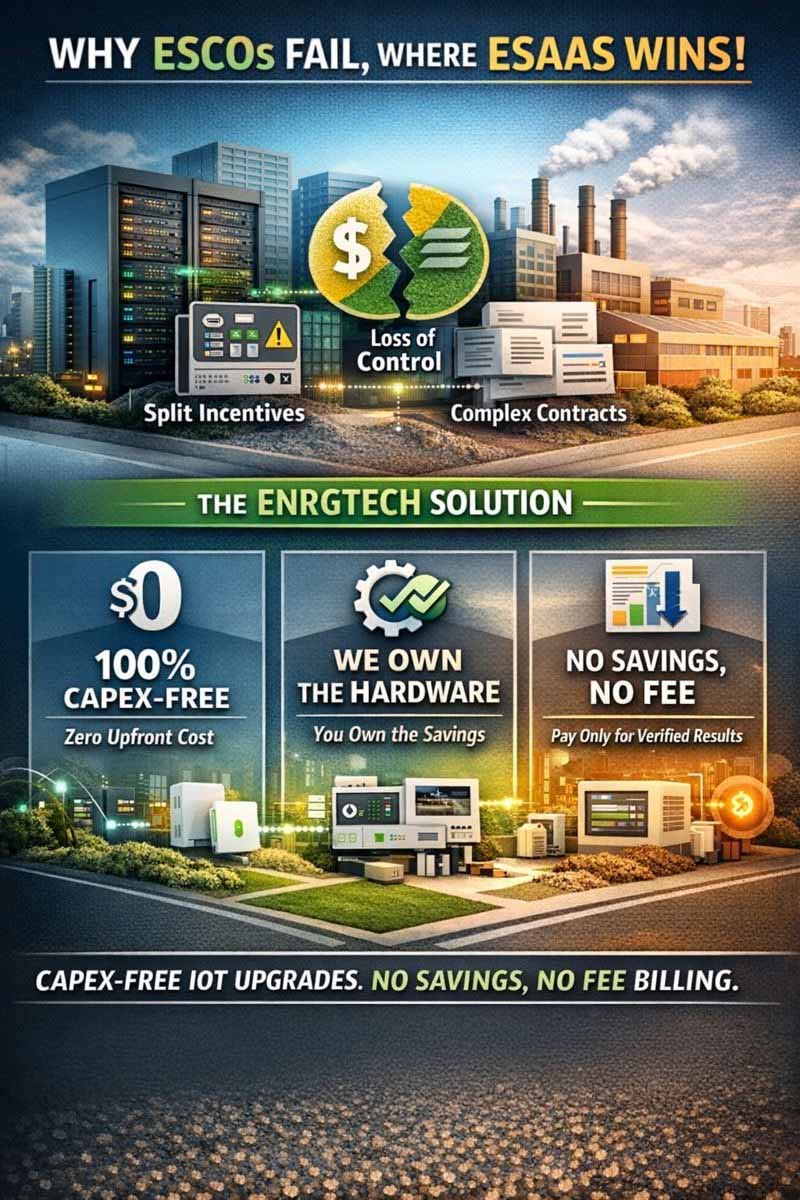
1. 100% Capex-Free Deployment: Traditional upgrades require a massive capital outlay or a complex loan. EnrgTech fronts the entire Capex. We deploy our proprietary hardware—including advanced IoT Gateways, Smart Sensors, and High-Precision Actuators—at zero cost to you.
2. We Own the Hardware, You Own the Savings: We remain the legal owners of the hardware throughout the contract. This isn't just a technicality; it’s a performance guarantee. Because the equipment is ours, we are incentivized to ensure every sensor is calibrated and every gateway is online 24/7. The Bottom Line: If our hardware doesn't perform, we don't get paid.
3. No Savings? No Fee: This is the ultimate alignment of interests. Unlike consultants who charge for "reports" or ESCOs that charge for "potential," EnrgTech only bills based on verified energy reduction.
4. Performance-Linked Billing: Our revenue is a direct percentage of the actual, metered dollars we shave off your utility bill.
5. Risk Transfer: We take on the technology risk, the installation risk, and the maintenance risk.
Why "As-a-Service" is the Future for 2026
Large operators are moving away from owning "depreciating assets" like old HVAC controllers. Instead, they are buying outcomes. By treating energy efficiency as a service, real estate leaders can:
- Protect Net Operating Income (NOI): By slashing the 33% OpEx slice.
- Avoid "Split Incentives": Our model is often easier to pass through in "green leases" because it shows a direct reduction in tenant utility costs.
- Maintain Agility: Since EnrgTech owns and manages the hardware, your facility team stays focused on core operations, not troubleshooting sensors.
- Stop Paying for Waste: The era of "fixed" utility costs is over. If your estate isn't using intelligent actuators and real-time sensor data to throttle consumption, you are leaving millions on the table.
Ready to see how much your estate could save without spending a dime in Capex? Visit EnrgTech.com to book a site-wide energy audit today.